
Online English tutoring for Australian students
PocketTutor helps students understand texts, develop ideas, practise language skills and improve their own writing. They can type or speak a question, upload class materials or share a draft for structured feedback from an AI tutor pitched to their year level.
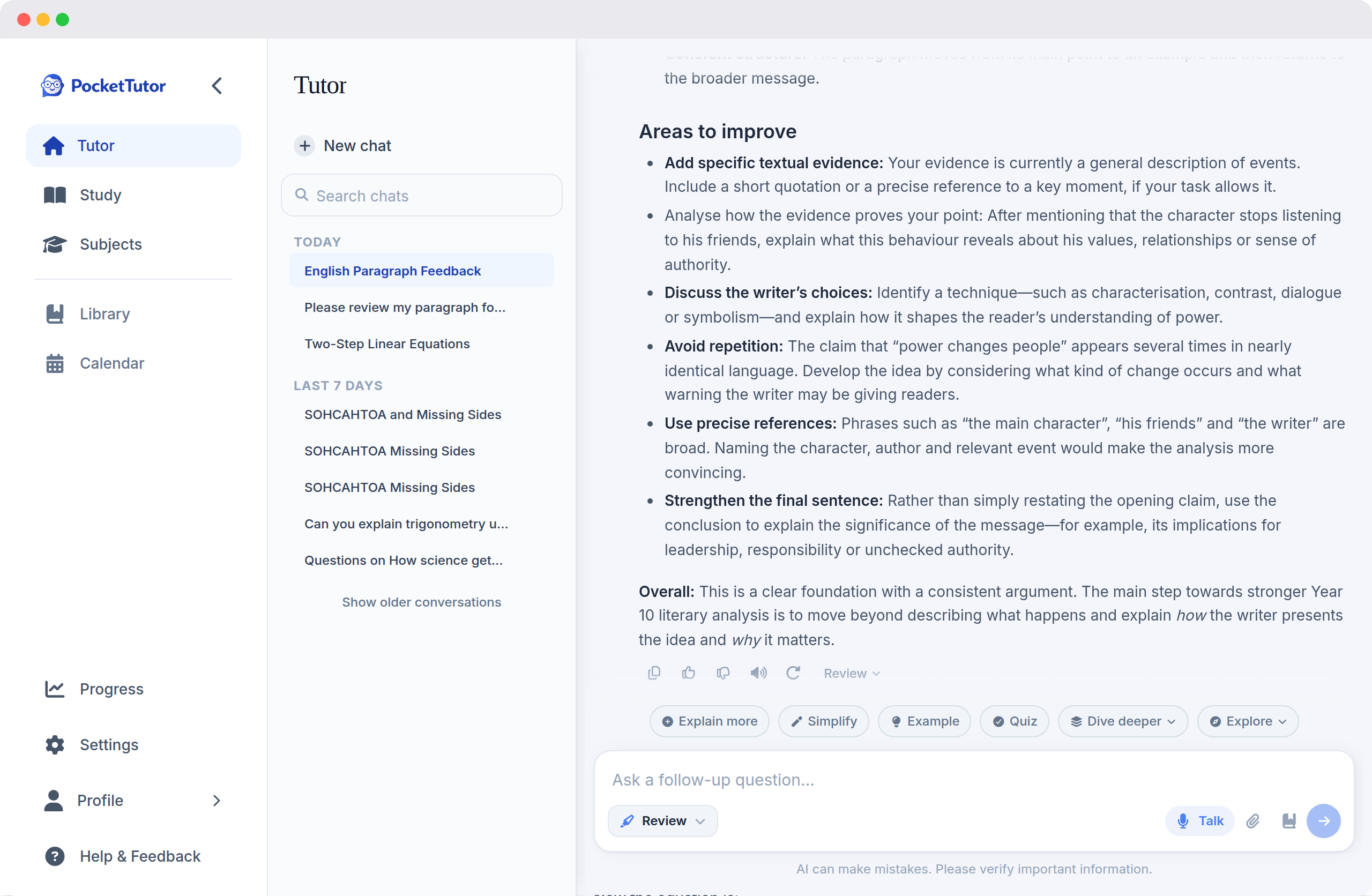
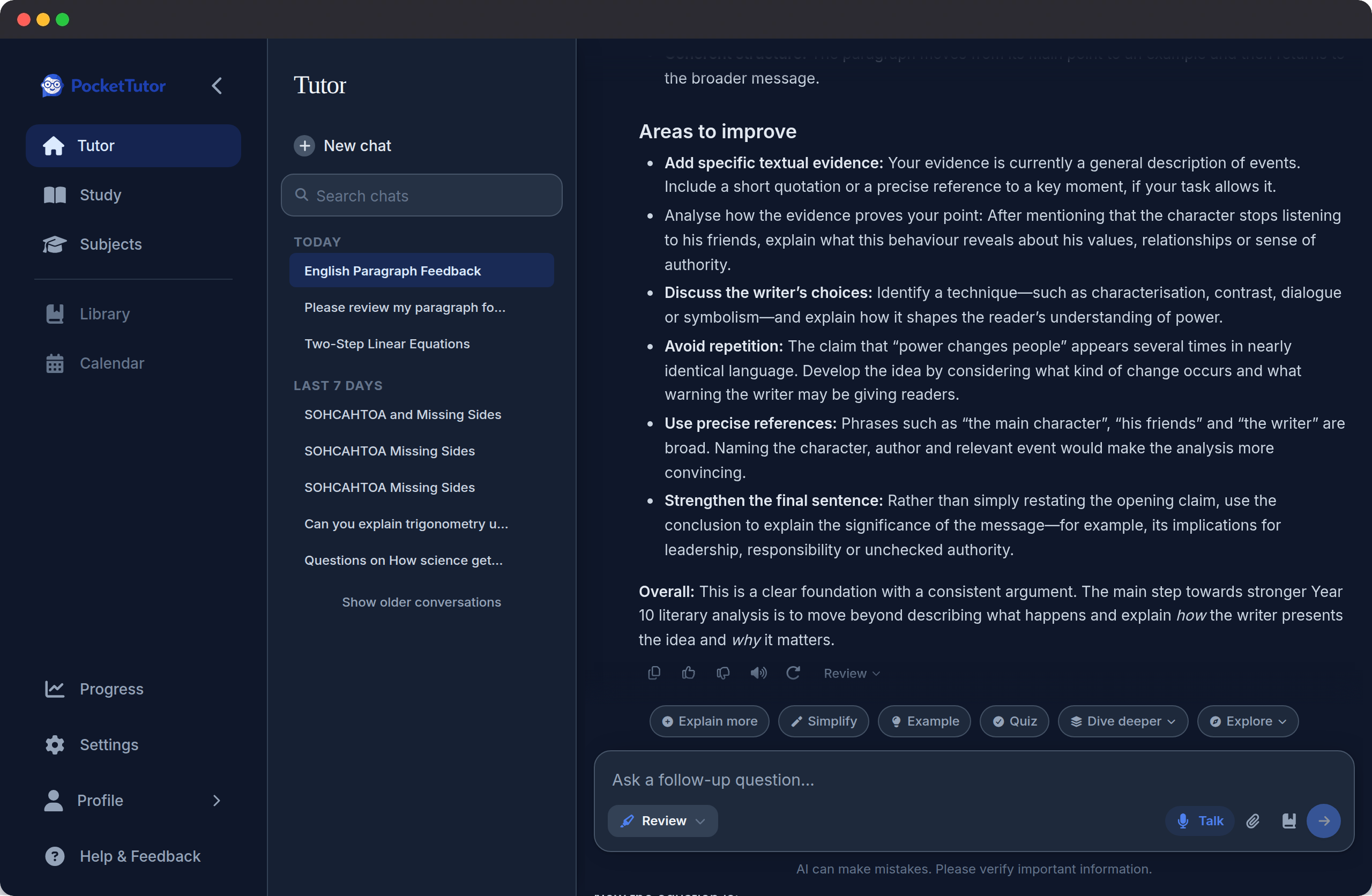
English help for reading, thinking and communicating.
English is not a single skill. A student may need to decode a younger-years text, understand unfamiliar vocabulary, analyse how an author creates meaning, organise an argument or edit a sentence so it says what they intend.
Understand the text
Practise the mechanics
Plan and revise
Feedback on the student's own writing.
For writing, PocketTutor's clearest role is coach rather than ghostwriter.
Review mode responds to their draft
The student stays the author
Ask about the text in front of you
Voice in, audio out
Requests that work well
- “Explain the difference between a metaphor and personification.”
- “Ask me questions about this passage, one at a time.”
- “What is the strongest evidence for my argument in this paragraph?”
- “Give feedback on my introduction without rewriting it for me.”
- “Quiz me on persuasive language.”
- “Turn these notes into flashcards.”
Read our guide to using AI for homework without cheating before using any AI tool on assessed writing.
Aligned to Australian English curricula
The Australian Curriculum: English is organised into the connected strands of Language, Literature and Literacy. ACARA describes students learning to read, view, listen, speak, write, create and reflect across increasingly complex texts. See the official Australian Curriculum: English for the complete rationale and structure.
PocketTutor uses that curriculum for Foundation to Year 10 and the relevant state or territory senior-secondary syllabus for Years 11 and 12. When the student works within a selected English subject, relevant syllabus content grounds explanations, quiz questions and feedback. Where a senior syllabus includes pathways or elective choices, PocketTutor can use the student's selected options when those choices are represented in the syllabus.
The classroom teacher still determines which texts are being studied, what a specific assignment requires and how it will be marked. ACARA notes that teachers and schools are best placed to select texts for their programs. Uploading the student's permitted class materials helps PocketTutor work with the immediate context, but teacher instructions should take priority.
Different teaching approaches for different students
PocketTutor has seven AI tutors with the same curriculum coverage and different teaching approaches. A student might choose Emma for patient steps, Simon for guiding questions, Mira for analogies, Aisha for focused practice, Ravi for first principles, Josh for a relaxed explanation or Sam for a balanced approach. They meet the tutors during onboarding, can accept a recommendation and can switch later.
PocketTutor also adjusts vocabulary, sentence length, examples and depth from the student's year level. A Foundation student and a Year 12 student will not receive the same explanation of audience, structure or language.
When an English teacher or human tutor is the better next step
PocketTutor can provide immediate explanation, feedback and repeated practice between lessons. A classroom teacher is the right source for the school's chosen text, the intended interpretation of a task, assessment rules and formal learning adjustments. A skilled human tutor can also observe spoken reasoning, build a relationship and diagnose broader patterns that an AI conversation may miss.
If a student has persistent difficulty with reading or written expression, needs support for a diagnosed or suspected learning need, or is distressed, involve the school and an appropriate professional. PocketTutor can complement that support; it does not replace it. To compare the roles honestly, read AI tutor vs human tutor.
Parent visibility without reading private conversations.
Coverage and progress, not transcripts
Minimal information about your child
Checked, but not infallible
Frequently asked questions
Bring your own question, text or draft.
Choose the student's state, year and subjects, then ask about a concept, upload permitted class material or request feedback on the student's own writing.